Punch Out Tiles and Tokens
PrintNinja has the printing and manufacturing experience to help create the highest quality tokens for your game. Learn more about some of our token options below.
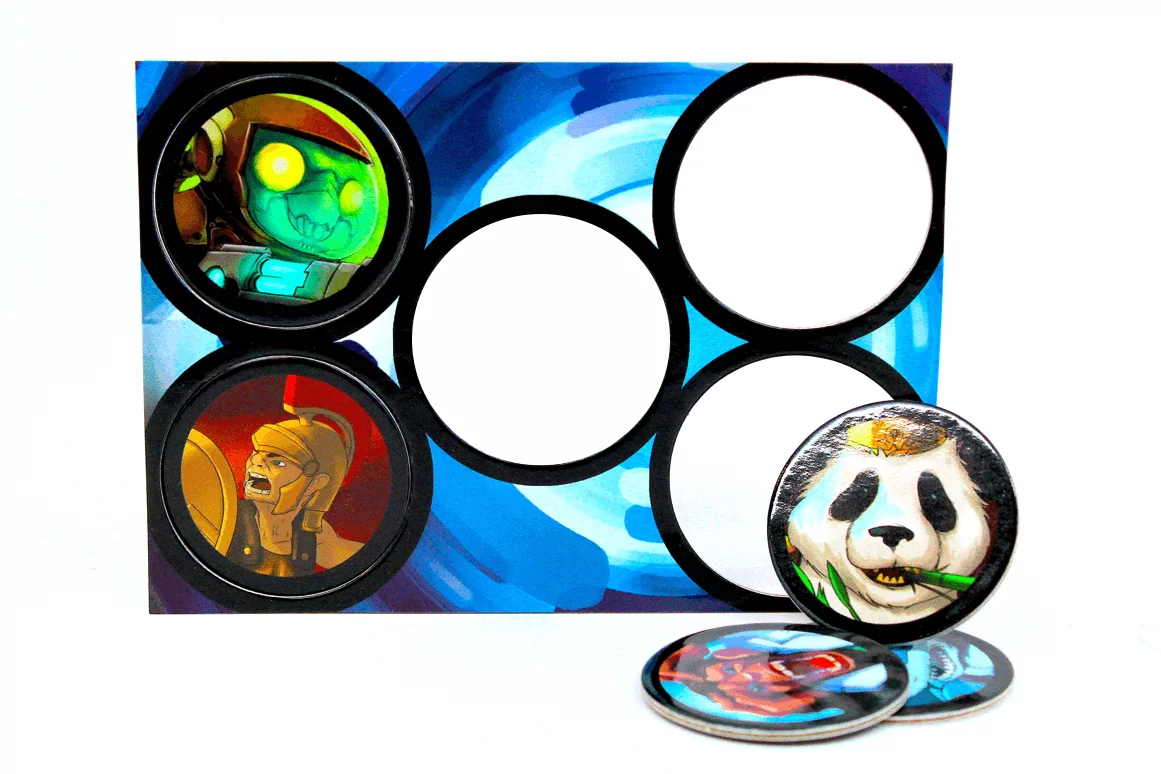
Premium PrintNinja punch out tokens
Punch Out Tokens
Does the game you’re designing involve tokens? If so, punch-out options could be an ideal addition to your project. Instead of receiving a series of tokens upon opening your game, your players get to experience punching them out of a pre-cut sheet when they open your game. This ensures all of the pieces are in one convenient location and allows your players to take an active role in game prep. Plus, the tokens will be in mint condition upon first opening the game instead of jostling about in the box.
How Punch-Out Tokens Are Made
Punch-out tokens (also called die-cut tokens, chits, or counters) are manufactured using a process similar to game boards: printed art paper is laminated onto thick greyboard, then cut into shapes using a custom steel-rule die.
The die is a flat board (usually plywood) with precision-bent steel blades embedded in it, forming the outline of each token shape. The die is mounted in a press, and when it descends onto the laminated sheet, the blades cut through most — but not all — of the board thickness. Small nicks (uncut connection points) hold each token in place within the sheet, allowing players to “punch” them out cleanly with finger pressure.
This manufacturing process follows the same die-cutting principles used across the packaging industry, governed by standards like ISO 16762:2016 (steel rule die specifications for paper and board conversion).
Size
While the size and shape of your token are customizable to whatever you need, PrintNinja creates punch tokens by die-cutting large, high-density greyboard sheets. We therefore only need to know the size of the sheet to formulate a quote for your project. To determine the right sheet size for your needs, calculate how many tokens you’ll need, then make sure they can all fit on the requested size. Don’t forget to account for the size of your two-piece box: the sheet must be small enough to fit inside. After you’ve submitted this information and requested a quote, we’ll get in touch to discuss the specifics, including token sizes and quantity.
Common Token Sizes
| Shape | Common Sizes | Typical Use |
|---|---|---|
| Circle | 15mm, 20mm, 25mm, 30mm diameter | Currency, health points, victory points, resource markers |
| Square | 20mm, 25mm, 30mm | Terrain tiles, status markers, counters |
| Hexagon | 25mm, 30mm flat-to-flat | Map tiles, territory markers (hex-grid games) |
| Custom shape | Varies | Thematic tokens (shields, swords, animals, etc.) |
The minimum practical token size is approximately 12mm in any dimension — smaller than that and the tokens become difficult to handle and the die-cutting precision is harder to maintain. The nick width (the tiny uncut bridges holding tokens in place) is typically 0.3–0.5mm — wide enough to hold the token securely in the sheet, narrow enough that it snaps cleanly without tearing the printed surface.
PrintNinja Tip
Some game designers like to include an empty bag in their game boxes so players have a safe place to store tokens after they've been punched out.
Material and Printing
The words “token” and “tile” are often used interchangeably, but these game pieces actually have two different functions. While tokens are usually a resource (a game piece used to collect winnings, for instance), tiles actually assemble the playing surface, also referred to as the game board. They are also made from different materials: while tokens comprise high-density greyboard, tiles are made from high-density paperboard.
| Component | Material | Typical Thickness | Function |
|---|---|---|---|
| Tokens / chits | High-density greyboard | 1.5–2.0 mm | Resources, currency, status markers — picked up and moved frequently |
| Tiles | High-density paperboard | 2.0–3.0 mm | Assemble the playing surface — placed and left in position |
| Standees | Greyboard + plastic base | 1.5–2.0 mm | Character or unit markers that stand upright on the board |
To produce your tokens, our operators will wrap a sheet of high-density greyboard in printed paper. You can choose to have just one side of the sheet wrapped, leaving the backside of the tokens exposed, or cover both sides so players can use either side of the token. After being covered by the printed paper, the greyboard is die cut with all of your requested shapes so players can pop out your tokens with ease!
Greyboard thickness is measured per TAPPI T 411 (thickness of paper and paperboard). The wrap paper is typically 157 gsm C2S (Coated 2 Sides) art paper — the same stock used for game board surfaces — printed in full CMYK with either gloss or matte lamination for durability.
Specialty Token Options
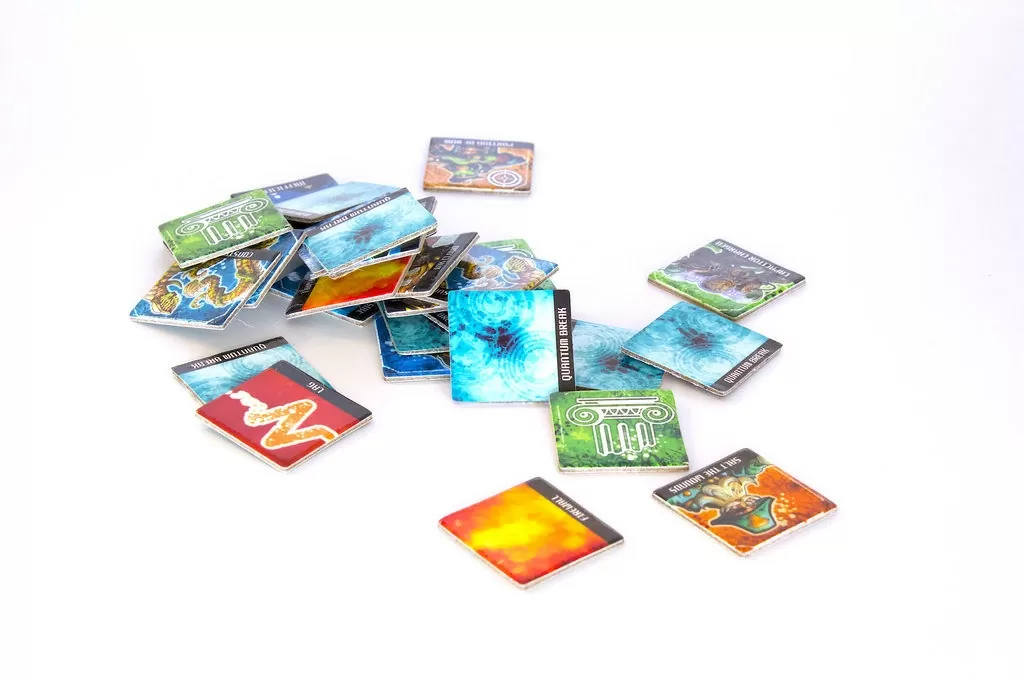
Premium PrintNinja tokens
If you’d prefer to limit the assembly steps needed to set up your game, consider selecting our special pre-punched token option. With this option, players will open their games and find a series of pre-punched tokens inside, ready for use. We recommend including a bag or organizing insert to prevent tokens from floating around inside the game box.
Another specialty option to consider is interlocking token pieces. Our die-cutting machine is able to create interlocking pieces, like those you’d find in a puzzle, allowing players to link pieces together.
Additional Specialty Options
- Linen texture — A cross-hatch pattern pressed into the printed surface, adding a tactile quality and helping hide minor wear from handling. The same finish used on commercial playing cards.
- Spot UV — A glossy UV coating applied to selected areas (e.g., icons or symbols on the token face) for visual contrast against a matte background.
- Foil stamping — Metallic foil applied to specific design elements. Popular for premium currency tokens (gold coins, treasure pieces).
- Double-sided printing — Different artwork on front and back, allowing tokens to flip between states (e.g., “undiscovered” → “revealed” territory tiles).
Multiple Variants
Do you have different pieces of artwork you’d like to incorporate onto your tokens? No problem! Just let us know how many varieties of artwork you’re thinking of so we can plan accordingly. The greater the number of variants, the more printing plates we may need to create (this is also based on sheet size).
Token Design Best Practices
Well-designed tokens improve gameplay by being immediately identifiable and pleasant to handle:
- Use distinct shapes for different token types — If your game has currency, health, and resource tokens, give each type a unique shape (circles for gold, squares for health, hexagons for resources). This lets players identify tokens at a glance without reading text.
- Color coding — Assign distinct colors to different values or factions. Follow colorblind-accessible design principles — approximately 8% of men have some form of color vision deficiency. The WCAG 2.1 guidelines recommend not relying on color alone to convey information; combine color with shape, pattern, or numeric value.
- Number the values — Always print the token’s value (1, 5, 10) on the face. Players shouldn’t need to memorize which color means which value.
- Keep safe area from die-cut edge — Keep all artwork and text at least 2mm inside the cut line to account for die-cutting registration tolerance.
Safety Standards for Game Tokens
If your game is marketed to children, punch-out tokens fall under toy safety regulations:
- ASTM F963-23 — The mandatory U.S. toy safety standard. Tokens that are small enough to fit inside the 16 CFR 1501 small parts test cylinder (1.25″ diameter x 2.25″ long) are classified as choking hazards for children under 3.
- EN 71-1 — The EU mechanical safety standard tests for sharp edges and small parts. Die-cut tokens must not produce sharp edges or splinters when punched out. However please note that PrintNinja is currently not shipping to the EU.
Games with small tokens intended for ages 3–6 must carry a choking hazard warning. Games labeled for ages 6+ are exempt from the small parts requirement but must still comply with chemical safety standards (lead content, heavy metal migration from printed surfaces).
File Setup
Looking for tips on setting up the artwork for your punch out tokens? Check out our extensive Setup Guides for step by step instructions with helpful visuals.